Loading component...
Loading component...
Loading component...
Source: American Cancer Society, American Society of Clinical Oncology, National Brain Tumor Society, National Cancer Institute, and Texas Cancer Registry
Source: American Cancer Society, American Society of Clinical Oncology, National Brain Tumor Society, National Cancer Institute, and Texas Cancer Registry
Brain cancer is due to the growth of abnormal (tumor) cells in the brain. Similar tumors occur in the spinal cord. While benign tumors generally do not invade other tissues, malignant (cancerous) tumors contain fast-growing cells that can spread to surrounding healthy brain tissue. Both benign and malignant tumors tend to cause symptoms by putting pressure on surrounding structures; however, malignant tumors tend to invade and destroy adjacent structures. There are two types of brain cancer: primary, which originates in the brain, and metastatic, the more common type, which begins elsewhere in the body and spreads to the brain.
In many cases, treating brain tumors requires extremely precise technology. Proton therapy can be used to treat certain brain tumors by delivering high doses of radiation to tumors with accuracy. While the treatment works to eliminate cancerous cells, it also minimizes exposure to non-targeted, healthy tissue surrounding the brain. As a result, patients get the benefit of extremely precise tumor targeting with a lower risk for potential side effects.
During treatment, a narrow proton beam is guided to focus the highest energy of the beam at the location of the tumor in the brain. While the proton beam is being delivered, it can also:
Proton therapy most often treats tumors in sensitive areas where conventional therapy may not be the best option. The accuracy of proton therapy makes it particularly useful in treating:
Once the proton beam enters the body at the targeted brain tumor, less radiation is administered. Then, after the proton beam hits the tumor, little to no radiation is delivered to help protect nearby tissue.
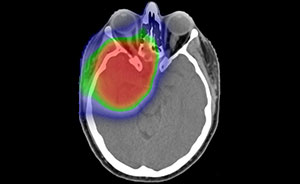
Proton Therapy
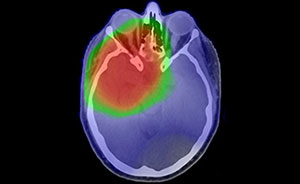
Conventional X-Ray Therapy
Red: High Radiation Dose
Green: Intermediate Radiation Dose
Blue: Low Radiation Dose
Most brain tumors have no known causes and known risk factors are few.
Brain cancer symptoms vary with each individual. People with these symptoms should consult their physician:
Other than reducing exposing the head to radiation, there are no known ways to prevent primary brain or spinal cord tumors. However, in adults, certain lifestyle changes, such as maintaining a healthy weight or quitting smoking, are believed to decrease the risk of developing cancers in the body, which could potentially reach the brain.
Treatment for brain cancer is determined by many factors, including tumor type; size and location in the brain; whether it’s newly diagnosed or a recurrence; the tumor’s specific genetic makeup and your overall health. Brain tumors can be very difficult to treat; therefore, many patients require a team of physicians including a neurosurgeon, neurologist, radiation oncologist, medical oncologist or neuro-oncologist, and an endocrinologist.
Surgery is the main treatment for brain tumors if located within the membranes covering the brain or in an area where removal would not damage the surrounding areas. Brain tumors that are located in or near sensitive areas can make total removal riskier, or occasionally impossible. Proton therapy is particularly useful in tumors deep in the brain or near sensitive areas due to the accuracy of the proton beam.
Several other treatments may be used such as radiation therapy, radiosurgery, proton therapy, chemotherapy, targeted therapy, or alternating electric field therapy. Often a combination of treatments is used to provide the best chance of disease control.

