Stages of Breast Cancer

Stage 0 Breast Cancer
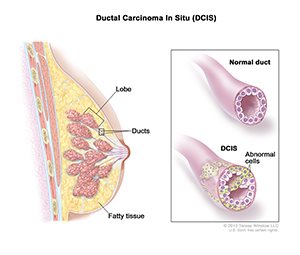
A stage 0 breast cancer diagnosis, also known non-invasive cancer or ductal carcinoma in situ (DCIS), signifies that abnormal cells are present in the breast milk duct lining. DCIS is the earliest form of breast cancer, representing about one in every five breast cancer diagnoses, and typically responds well to treatment since the cancerous cells have not spread to other tissues in the body.
Stage I Breast Cancer
In stage I, cancer is present in the breast tissue, but has not yet spread to other areas of the body. This stage is divided into stage IA and stage IB.
Stage IA breast cancer
Breast cancer is characterized by a small tumor, no larger than two centimeters. At this point, cancerous cells have not entered the lymph nodes.
Stage IB breast cancer
Breast cancer is characterized by cancerous cells in the lymph nodes. In this stage, either no tumor will be present, or only a small tumor no larger than two centimeters will be present.
Breast cancer is highly treatable when detected in stage I, with a five-year survival rate close to 100 percent.
Stage II Breast Cancer
A stage II breast cancer diagnosis indicates that abnormal cells are present and growing. In some cases, cancerous cells may have spread to the lymph nodes, but have not progressed to other areas of the body. This stage is divided into stage IIA and stage IIB.
Stage IIA breast cancer
Stage IIA breast cancer is characterized by one of the following:
- Cancerous cells have spread to up to three nearby lymph nodes, but there is no tumor.
- Cancerous cells have spread to up to three nearby lymph nodes, and there is a small tumor up to two centimeters.
- Cancerous cells have not spread to the lymph nodes, but there is a small tumor between two and five centimeters.
Stage IIB breast cancer
Stage IIB breast cancer is characterized by one of the following:
- Cancerous cells have spread to up to three lymph nodes, and there is a small tumor between two and five centimeters.
- Cancerous cells have not spread to the lymph nodes, but there is a tumor larger than five centimeters.
Stage III Breast Cancer
A stage III breast cancer diagnosis indicates that cancerous cells have begun to grow and spread to lymph nodes and nearby muscles. At this stage, the cancer has not yet progressed to other organs in the body. Stage III breast cancer is divided into stage IIIA, stage IIIB and stage IIIC.
Stage IIIA breast cancer
Stage IIIA breast cancer is characterized by one of the following:
- Cancerous cells have progressed to between four and nine lymph nodes, and no tumor is present or only a small tumor is present (less than two centimeters).
- Small clusters of cancerous cells are present in the lymph nodes with a tumor greater than five centimeters.
- Cancerous cells are present in up to three lymph nodes near the breastbone or underarm with a tumor greater than five centimeters.
Stage IIIB breast cancer
Stage IIIB breast cancer is characterized by having any size tumor present; cancerous cells in the chest wall or breast skin with inflammation or ulcers or diagnosed as inflammatory breast cancer; and cancerous cells in up to nine lymph nodes under the arm but has not spread to other parts of the body.
Stage IIIC breast cancer
Stage IIIC breast cancer is characterized by one of the following:
- Cancerous cells have progressed to 10 or more lymph nodes under the arm with or without a tumor of any size. Cancer may have penetrated the chest wall or breast skin with inflammation or ulcers.
- Cancerous cells have progressed to the lymph nodes near the collarbone with or without a tumor of any size.
- Cancerous cells have progressed to the lymph nodes near the breastbone or underarm with or without a tumor of any size.
Several treatment options are available at stage III. Most women will benefit from some combination of two or more treatments.

Stage IV Breast Cancer
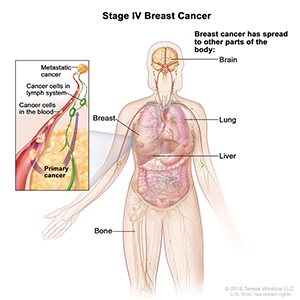
Stage IV, or metastatic, breast cancer, characterizes breast cancer cells that have spread from the breast and/or axillary lymph nodes to other parts of the body. The most common sites of metastatic breast cancer are bone, liver, lungs, and brain.
While metastatic breast cancer may never completely go away, there are treatments that can keep it under control for a number of years. It is important to establish care with a medical oncologist who can tailor treatments to your specific type of breast cancer. In addition, there are a number of promising clinical trials at Texas Oncology for women with metastatic breast cancer from which you may benefit. Many women live an active life while undergoing treatment for metastatic breast cancer.
Recurrent Breast Cancer
Recurrent breast cancer describes breast cancer that returns after treatment. Local recurrence is when breast cancer recurs in the same area as the original breast cancer. Regional recurrence is defined as recurrence in the nearby lymph nodes. Distant recurrence is cancer that recurs at distant sites, most commonly the bones, liver, lungs, or brain.
Recurrence can happen if some cancer cells evade the initial treatments. This does not mean the cancer was treated insufficiently, but rather that some cancer cells survived the treatment and developed into detectable tumors over time.
When a cancer spreads or worsens, it is called cancer progression. It may be difficult to determine the difference between cancer progression and cancer recurrence. Typically, if a patient appears to be cancer-free at the end of treatment, and the disease reappears after having no signs for a year, it is considered a recurrence. If the tumor grows while on treatment or never completely disappears and grows again after treatment, it is called progressive disease.
Similar to a primary cancer, treatments for a recurrent cancer can be used to control and eliminate cancer as well as manage pain and side effects. The treatment selected is dependent on a number of factors, including the location of recurrence, timing of recurrence, extent that the cancer has spread, and overall patient condition.